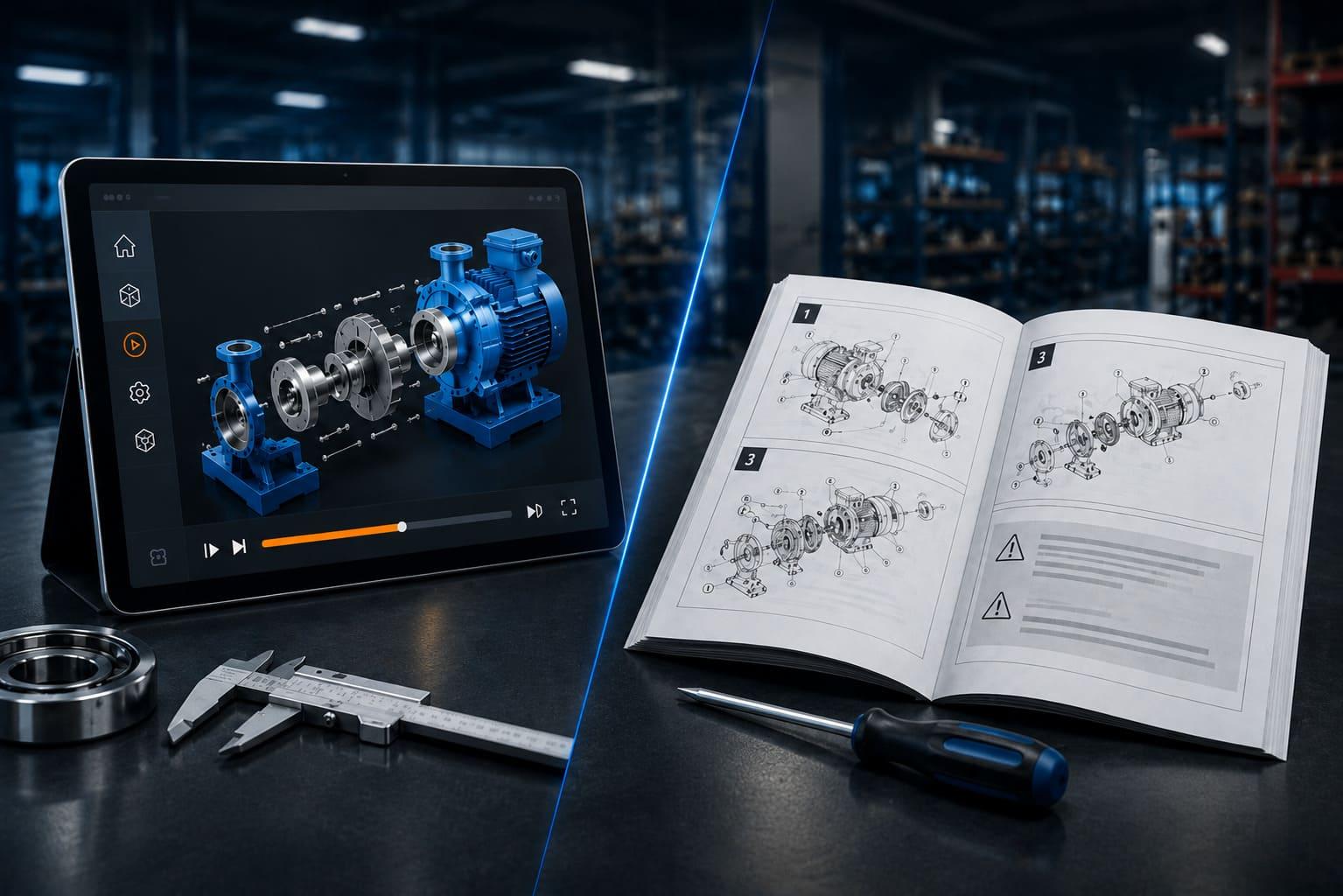
When a technician misreads a step in a printed guide and assembles a critical component backwards, the cost isn't just a replacement part - it's downtime, rework, and eroded trust. Complex industrial products demand crystal-clear instructions, yet many manufacturers still rely on dense PDF manuals packed with 2D diagrams and numbered steps. Today, 3D assembly animation for industrial products is challenging that long-standing norm. So which format genuinely delivers better results? Let's break it down.
3D assembly animation is a digital, motion-based format that walks viewers through product assembly using rendered three-dimensional models. Unlike static images, these animations show components moving into place - rotating, sliding, snapping - from any angle.
In the industrial context, a machinery assembly walkthrough video can depict an exploded view animation that separates every part, highlights torque points, and guides the viewer through each step with precision. These are commonly used for heavy equipment, CNC machinery, conveyor systems, electrical panels, and complex electronic assemblies. As a form of visual assembly instructions industrial manufacturers increasingly prefer, 3D animation removes the guesswork from spatial orientation entirely.
The installation manual has been the industry default for decades. A typical document includes numbered steps, 2D line diagrams, parts lists, torque specifications, and safety warnings all formatted for print or PDF distribution.
For many industries, printed documentation isn't optional - it's mandated by compliance frameworks. Installation manuals are portable, don't require a device or internet connection, and serve as a reliable quick reference during field work. The digital vs printed instruction manual debate often acknowledges that manuals have real utility; the question is whether they're sufficient on their own for today's complex assemblies.
When assembly involves spatial relationships - which face of a bracket faces inward, which port aligns with which channel 3D assembly animation vs instruction manual comparisons consistently favour animation. A 3D mechanical assembly animation can rotate a component 360°, zoom into a socket, and show the exact motion of insertion. A 2D diagram can only hint at depth.
For straightforward assemblies with minimal interdependencies, a well-structured manual is adequate. But as component count and spatial complexity increase, visual technical documentation in animated form dramatically reduces cognitive load.
Industrial workforces are multilingual. A text-heavy manual in English may be inaccessible to a technician whose first language is Tamil, Portuguese, or German. Multilingual assembly instructions delivered as animation reduce dependence on language entirely - motion is universal.
An animated installation guide can convey "insert tab A into slot B at a 45-degree angle" without a single word. This makes 3D assembly animation services particularly valuable for manufacturers distributing globally or managing diverse shop-floor teams.
Studies in technical communication consistently show that reducing assembly errors with video is one of the most measurable benefits of animated formats. When a technician watches a step being performed correctly - seeing the exact angle, sequence, and fit - they replicate it more accurately than when decoding a diagram.
Replacing printed manuals with animation in high-stakes assembly environments has been linked to measurable reductions in warranty claims, field service calls, and production defects. For an industrial product explainer video that doubles as a work instruction, the ROI is tangible.
Product changes happen, a revised fastener, a new cable routing, a component substitution. Updating a printed manual means reprinting and redistributing. An animated work instruction stored digitally can be revised and redeployed rapidly, with versioning control.
That said, 3D animation for industrial products does carry a higher initial production cost. Revisions to 3D models require access to source files and skilled animators. A well-structured manual, by contrast, can be edited in-house with basic tools.
Candidly, product installation animation services require more upfront investment than manual creation.Studios like Acoroid Studio, a 3D industrial animation company in India can produce professional assembly animations at competitive rates compared to Western counterparts, but the cost is still higher than typesetting a PDF.
However, over the product lifecycle, the long-term value often outweighs initial cost particularly when factoring in error reduction, support call deflection, and reuse across training and sales contexts.
3D assembly animation for industrial products decisively outperforms manuals in several scenarios:
Multi-part mechanical assemblies - Where components interact in three dimensions a gearbox, a hydraulic manifold, a multi-stage conveyor system
Spatial orientation-dependent components - Where "this way up" or "clockwise until resistance" is difficult to convey in 2D
Remote and unsupervised installation - When a field technician has no expert on hand, an equipment setup animation is the closest thing to having a trainer present
Onboarding new technicians - An industrial onboarding video dramatically reduces the ramp-up time for workers unfamiliar with a product line
Global distribution - Where multilingual assembly instructions in visual format eliminate translation overhead
For any industrial machinery animation company in India or globally, these use cases represent the strongest commercial argument for animation-first technical communication.
An honest industrial product assembly guide comparison must acknowledge where printed manuals remain strong:
Low or no-connectivity environments - offshore rigs, basement plant rooms, and remote mine sites may have no device or signal available
Regulated industries - sectors such as aerospace, pharma, and defence often require printed documentation for audit and compliance purposes
Quick field reference - a technician mid-task needs to check a torque value fast; flipping to a page is faster than loading a video
Cost-sensitive small production runs - for a manufacturer producing 50 units per year, commissioning a full 3D animated explainer video may not be commercially justified
Legal documentation - manuals carry signatures, revision histories, and disclaimers that have evidentiary weight
The digital vs printed instruction manual debate isn't won by animation in every context. Format should follow function.
The most forward-thinking industrial machinery animation company in India and globally are moving beyond the binary choice. Leading manufacturers are pairing both formats:
QR codes embedded in printed manuals - That link to step-specific machinery assembly walkthrough videos
Digital manuals - With embedded animation clips for complex steps, with static diagrams for simple ones
Tablet-based assembly stations - That display an animated work instruction while a paper checklist confirms completion
Companies like Bosch Rexroth, Siemens, and Caterpillar have pioneered this integration, embedding motion graphics for industrial use into broader digital work instruction systems. The result: the accessibility of print with the comprehension power of 3D product visualization.
A 3d assembly animation services provider that can also support structured document integration becomes a strategic partner, not just a production vendor. Acoroid Studio specialises in exactly this - delivering both standalone animations and hybrid documentation systems tailored for industrial manufacturers.
Use this quick decision framework:
High part count + spatial complexity? - 3D assembly animation is essential
Multilingual or global workforce? - Animation reduces language dependency
Regulated industry requiring print compliance? - Hybrid approach: animation plus compliant documentation
Small production run or tight budget? - Start with a strong manual; add animation for the most error-prone steps
Training new technicians at scale? - Animation for factory technicians and onboarding delivers measurable time savings
The right answer depends on your product, audience, distribution environment, and budget - but for most complex industrial products, the case for 3D assembly animation grows stronger with every additional component.
Neither format is universally superior - but for complex industrial products, 3D assembly animation increasingly delivers better comprehension, fewer errors, and stronger outcomes for multilingual, globally distributed workforces. Traditional installation manuals retain real value in compliance-driven, low-connectivity, and cost-sensitive contexts. The smartest manufacturers aren't choosing one over the other - they're building hybrid systems that harness the strengths of both.
Technical communication is evolving. The question isn't whether visual assembly instructions industrial manufacturers use will replace printed guides - it's how quickly the two will fully converge.
3D assembly animation for industrial products is a rendered, motion-based format that shows how components fit together step by step using three-dimensional models. Unlike static 2D diagrams, these animations display exploded view animation, rotational views, and real-time movement, making complex visual assembly instructions industrial teams use far easier to follow accurately.
3D product animation reduces errors by showing the exact motion, orientation, and sequence of each assembly step - leaving little room for misinterpretation. Reducing assembly errors with video has been documented across manufacturing sectors, with measurable reductions in rework, warranty claims, and field service calls compared to text-and-diagram manuals.
Traditional installation manuals remain the right choice in regulated industries that require printed documentation for compliance audits, in low or no-connectivity environments where digital playback isn't possible, and for cost-sensitive small production runs where the investment in a full animated installation guide isn't commercially justified.
The cost of 3D assembly animation services in India varies based on complexity, number of components, animation length, and level of detail. Working with a 3D industrial animation company in India typically offers significant cost advantages over Western production, without compromising quality. Most product installation animation services are priced per minute of finished animation, with complexity-based tiers.
Absolutely in fact, the hybrid approach is recommended for most complex industrial products. You can embed QR codes in your printed manual that link to specific machinery assembly walkthrough video clips, or integrate animation into a digital manual format. This gives you both the compliance coverage of a visual technical documentation package and the comprehension advantages of motion-based instruction.

