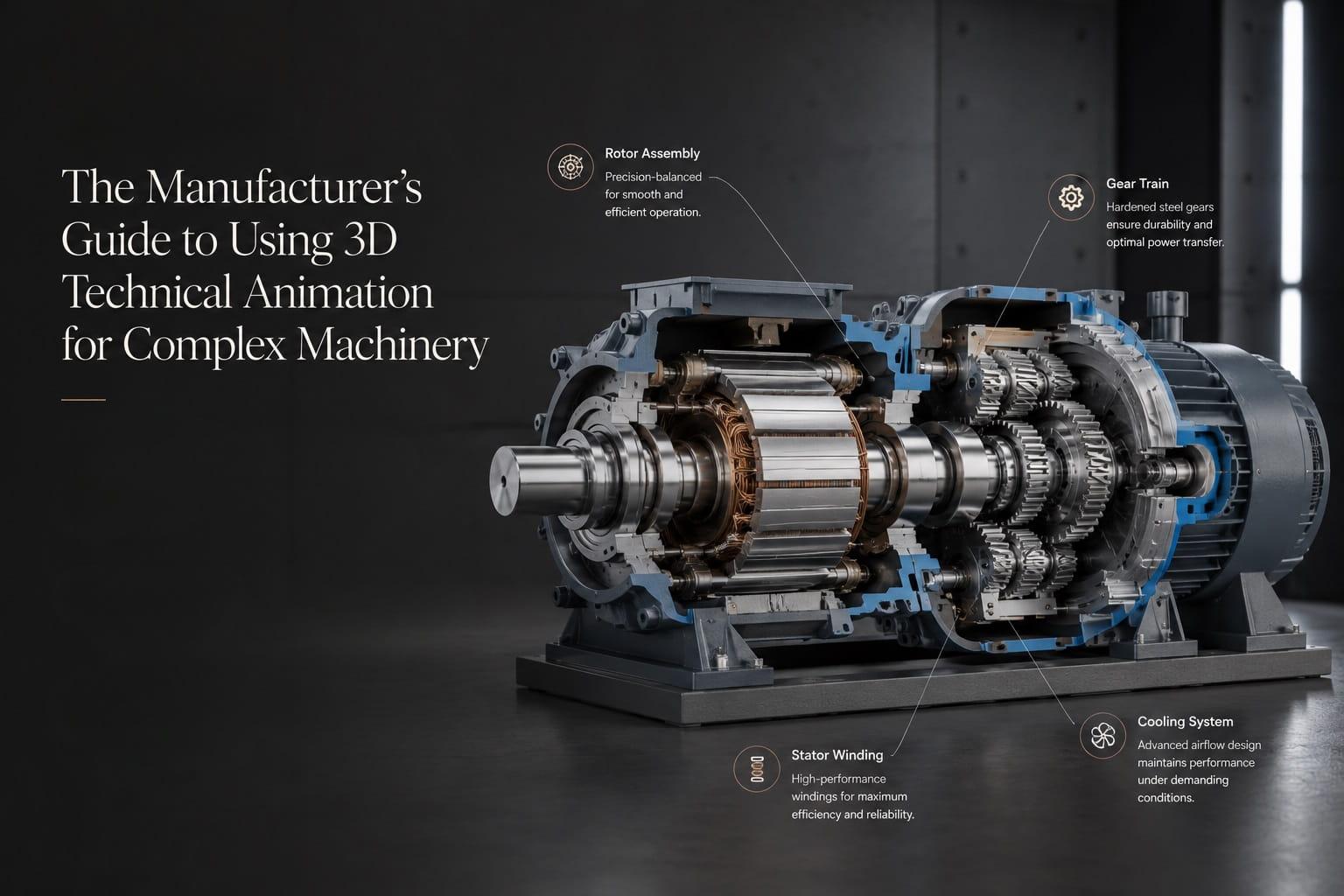
In the modern industrial B2B market, traditional marketing and sales methods are quickly losing their effectiveness. When your engineering business develops highly complex machinery, custom internal valves, heavy industrial equipment, or multi-layered manufacturing assemblies, static photography simply falls short. Prospective corporate clients, procurement officers, safety inspectors, and global investors want to see exactly how your engineering innovation functions before they commit to high-ticket purchase contracts.
To bridge this critical communication gap, forward-thinking manufacturing brands are actively partnering with a specialized 3D technical animation company. Utilizing high-impact industrial 3D animation services allows your brand to break down complex engineering concepts into clear, engaging, and highly persuasive visual assets.
Whether your goal is to explain an intricate automated workflow, train field technicians, or market heavy equipment to international buyers online, a dedicated 3D hardware animation agency can seamlessly convert your raw CAD data into powerful sales conversion tools. Here is an in-depth look at why investing in high-fidelity 3D mechanical animation is the ultimate game-changer for engineering and industrial manufacturing brands looking to scale their digital footprint.
Traditional corporate photography, printed brochures, and text-heavy operations manuals are no longer sufficient to close deals in modern B2B industries. If your machinery features hidden internal components, custom gear designs, or proprietary internal workflows, a standard outer metal casing completely hides your innovation from the customer's view. You cannot expect a buyer to fully appreciate your product if they cannot see what makes it superior.
This is precisely where a specialized 3D technical animation company steps in to solve the problem. By leveraging advanced 3D mechanical animation workflows, engineering and design teams can peel back the external steel layers of any industrial machine. This lets your target audience clearly visualize internal fluid dynamics, complex gear ratios, electrical current pathways, and structural stresses moving through the system in real time.
Instead of overwhelming your prospects with dense, confusing blue-prints and technical jargon, industrial 3D animation services convert complex data into intuitive, photorealistic visuals that anyone can comprehend within seconds. If you want your global marketing campaigns to resonate across languages and borders, shifting away from static media toward dynamic engineering product video production is an absolute commercial necessity.
A professional 3D equipment rendering studio can create highly customized visual assets tailored to different stages of your B2B customer journey. The most effective applications include:
X-Ray and Cross-Sectional Views: Highlight internal components, gas flows, and mechanical interactions perfectly without needing to cut open or destroy expensive physical equipment.
Exploded Assembly Videos: Beautifully break a complex machine down into its hundred individual micro-components, showcasing materials and tolerances, before assembling them back together seamlessly on screen.
Interactive 3D Product Visualizations: Allow your clients to rotate, zoom, slide panels, and inspect custom hardware configurations directly via standard web browsers during sales pitches.
Maintenance and Safety Training Animations: Replace confusing, dangerous text manuals with step-by-step visual guides that show technicians exactly how to service parts safely.
By integrating these specialized production techniques, a top-tier 3D technical animation company ensures that your sales pitches are backed by unforgettable visual clarity. These digital assets elevate your standard sales deck into an immersive digital showroom experience that builds instant credibility with engineering teams.
Investing in enterprise-grade industrial 3D animation services is not just an aesthetic upgrade or a marketing luxury; it directly protects, optimizes, and scales your company's revenue margins. Here is exactly how high-end visualization drives corporate growth:
B2B buying committees often take months to make a decision because they do not fully understand the technical advantages of your proprietary system over cheaper alternatives. High-quality 3D mechanical animation resolves engineering objections instantly. When corporate stakeholders can clearly see your machinery outperforming competitors on screen, the time required to secure sign-off and close a deal drops drastically.
When you invest in professional engineering product video production, you are creating highly versatile, reusable digital assets. A single high-fidelity 3D model built by a 3D technical animation company can be broken down into social media snippets, website hero videos, interactive trade show displays, pitch decks, and internal training guides. You write the check once, and the asset pays dividends across multiple departments for years.
Building and shipping massive physical prototypes to international trade shows is a logistically exhausting, expensive nightmare. By opting for virtual asset creation, you can launch worldwide marketing campaigns, collect pre-orders, and close international distribution contracts before the real machinery ever rolls off the factory floor. Your sales team can carry an entire heavy equipment inventory directly on a tablet computer.
Understanding how a professional 3D technical animation company works can help your engineering team prepare assets efficiently. The process involves several highly technical phases:
CAD Data Ingestion: Securely transferring your raw engineering files (STEP, IGES, or SolidWorks files) into the animation environment.
Model Optimization (Retopology): Cleaning up the heavy CAD geometry so that the software can animate complex movements smoothly without lagging or crashing.
Material and Shader Mapping: Applying photorealistic textures to metals, plastics, rubber hoses, and glass components to ensure they look real.
Rigging and Animation: Programming the real-world physics, rotation axes, and linear movements so components move with mechanical accuracy.
Lighting and Rendering: Setting up studio lighting arrays and processing the final frames using high-powered render farms.
This rigorous technical pipeline ensures that your final video asset is mathematically accurate and visually stunning.
Creating hyper-realistic mechanical movements requires deep artistic precision paired with strict technical compliance. Generalist design agencies or creative video firms often make heavy steel industrial machinery look like cheap plastic toys because they don't understand engineering principles.
When scouting for a long-term production partner, look for a team that can natively handle complex CAD conversions, read technical schematics, and simulate real-world physics flawlessly. Many global manufacturing brands choose to work with studios providing specialized outsourced 3D animation services India to secure enterprise-grade production values at highly competitive, scalable rates.
This is where our team at Acoroid Studio excels. As a trusted 3D Technical Animation Company, we bridge the gap between rigorous engineering specifications and high-converting marketing content. We work directly with your step files and CAD models to create flawless, photorealistic 3D Product Visualizations that educate your target audience, demystify complex systems, and compel procurement officers to take action.
Relying on traditional text manuals, static photos, and flat 2D diagrams puts your industrial brand at a severe competitive disadvantage in today's digital-first procurement world. Embracing the power of 3D mechanical animation equips your international sales team with an irresistible asset that functions 24/7 across the globe.
Ready to showcase your heavy machinery with absolute visual clarity? Explore our comprehensive range of specialized 3D Industrial Architecture and Engineering Animation Services to see how we can bring your blueprints to life.
Contact Acoroid Studio today to request a custom quote, schedule a consultation, and take your B2B industrial marketing strategy to the next level.
3D technical animation is the use of computer-generated imagery to create precise, movement-based visualisations of complex machinery, mechanical assemblies, and industrial processes. In manufacturing, it is used to demonstrate how equipment operates internally, communicate engineering concepts to non-technical stakeholders, support sales presentations, simplify training, and replace costly physical prototypes during the product development cycle.
Static media such as 2D drawings, photographs, and PDF datasheets cannot convey motion, assembly sequences, or internal mechanical interactions. For complex machinery with moving parts, hidden components, or multi-stage processes, static visuals leave engineers, buyers, and operators with critical knowledge gaps - gaps that 3D mechanical animation resolves by showing exactly how a machine functions in real time.
The CAD-to-animation pipeline converts existing engineering CAD files typically in formats such as STEP, IGES, or SolidWorks into animated 3D visualisations. The process involves CAD data optimisation, material and texture application, rigging of mechanical movements, camera and lighting setup, rendering, and post-production. This pipeline preserves engineering accuracy while producing broadcast-quality video output for sales, training, or technical documentation.
The ROI of 3D mechanical animation in engineering comes from reduced physical prototyping costs, shorter sales cycles, lower training expenditure, and fewer field errors caused by misunderstood instructions. Manufacturers report that animated product demonstrations increase buyer confidence and accelerate purchasing decisions particularly for capital equipment where buyers cannot easily witness live machine demonstrations before committing to large investments.
When selecting an industrial 3D animation partner, manufacturers should evaluate CAD file compatibility, experience with mechanical and engineering subjects, technical accuracy in motion simulation, and the ability to work directly with engineering teams. Additional criteria include turnaround time per project, scalability across product lines, post-production capabilities, and a verifiable portfolio of complex machinery or manufacturing animation work.