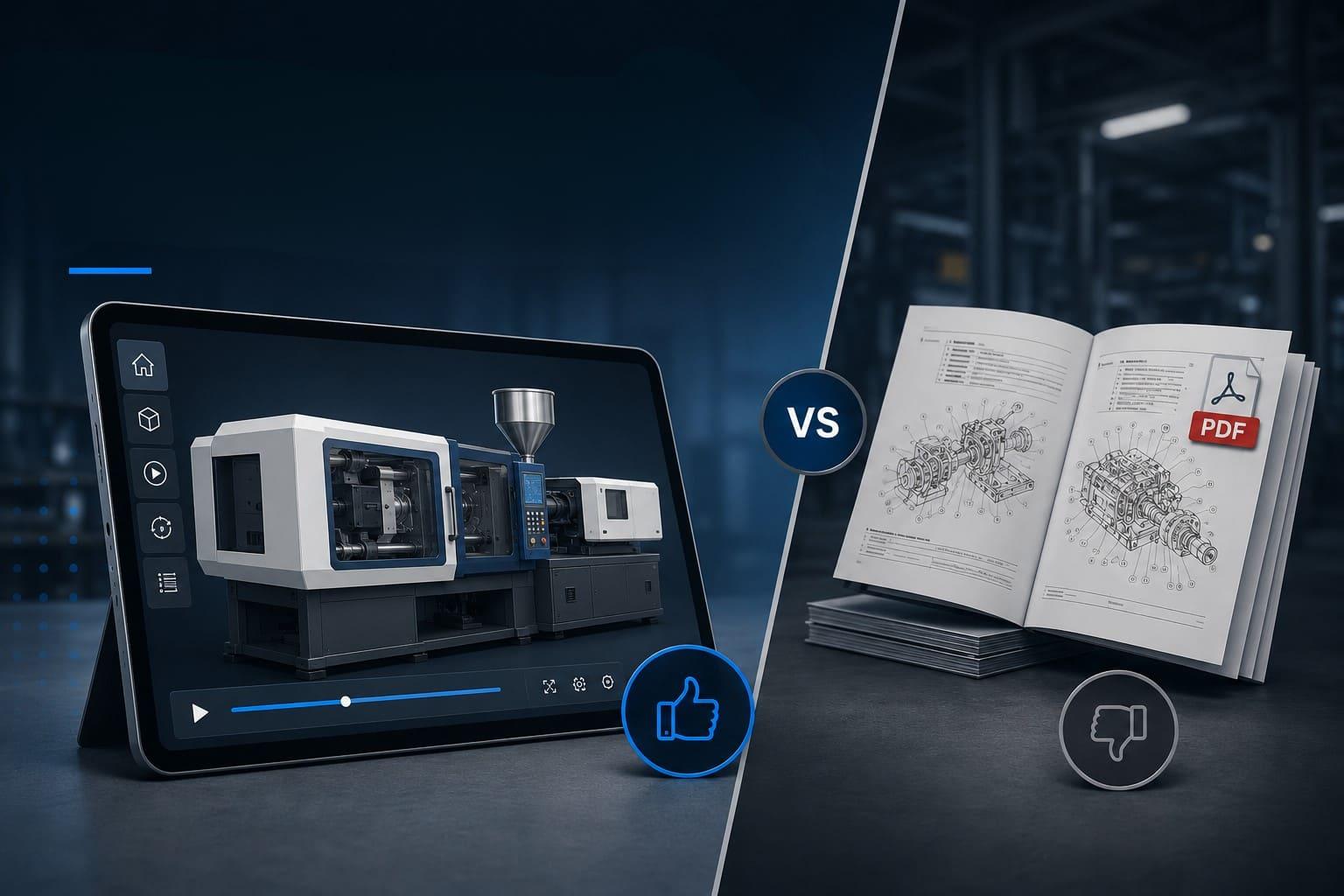
Industrial manufacturing equipment requires precise assembly, operation, and maintenance. For decades, the standard method for sharing this information was the traditional PDF manual. However, procurement teams, factory managers, and field engineers face massive friction when interpreting flat, two-dimensional text layouts.
Industrial machinery buyers prefer 3D technical animation because it eliminates spatial ambiguity, bypasses language barriers, and provides clear visual proof of mechanical workflows that static documentation cannot replicate. By partnering with expert visualization teams like Acoroid Studio, manufacturers accelerate buyer comprehension, reduce equipment downtime, and build long-term operational trust.
Static documentation creates an immediate informational bottleneck during the post-purchase phase of industrial equipment. Heavy machinery features intricate internal components, complex electrical routing, and precise hydraulic systems. Documenting these features on a flat page forces the end-user to mentally translate a 2D drawing into a 3D physical environment.
This mental translation increases cognitive fatigue and leads to critical interpretation errors. Factory technicians frequently misinterpret assembly sequences, torque specifications, or component orientations when relying on crowded orthographic projections. Furthermore, text-heavy PDFs require extensive translation budgets for global distribution, yet localized text often fails to capture the exact mechanical nuances of the original design. When an operative misunderstands an installation step, the consequences include damaged parts, delayed production schedules, and strained client relationships.
The cost of a single misread step can be catastrophic. In high-pressure hydraulic setups or heavy forging equipment, a bolt torqued out of sequence or a seal placed backward can lead to immediate component failure upon system pressurization. Paper manuals attempt to address this by adding warning labels and footnotes, but text density often causes operators to miss critical safety instructions.
Technical animation bridges the gap between raw engineering data and clear visual communication. Instead of starting from scratch, animation specialists utilize the manufacturer’s actual production CAD files. These source files undergo an optimization pipeline where heavy geometry is streamlined for smooth rendering without sacrificing geometric accuracy or spatial dimensions.
The resulting asset is a photorealistic, chronologically precise motion sequence. It illustrates exactly how moving parts interact, how media flows through valves, and how internal gears mesh. Unlike standard marketing videos, technical animation focuses on mechanical accuracy, logical assembly orders, and internal visibility via cross-sectional cuts. This provides a level of clarity that physical video cannot achieve, as physical cameras cannot peer through solid steel casings to show internal operations.
Through advanced rendering techniques, non-visible forces such as gas expansion, liquid flow, heat dissipation, and electrical currents are visualized using particle systems and color-coded overlays. This turns abstract engineering concepts into tangible, easily understood visual processes, allowing both technical and non-technical stakeholders to observe the machine's exact internal behavior during operation.
B2B buyers look for efficiency, safety, and rapid deployment. When purchasing million-dollar industrial assets, procurement teams evaluate the total cost of ownership, which includes the time required to train staff and deploy the machinery. 3D technical animations provide a direct financial advantage by accelerating the onboarding process for field engineers.
A visual walkthrough functions as a universal language. It bypasses the need for multi-lingual translation by showing the exact physical actions required to operate a machine. Operatives see the precise angle of approach, the exact tool placement, and the real-time behavioral response of the machinery. This clarity removes guesswork, building immediate confidence in the buyer’s technical teams and ensuring that the machinery operates at peak efficiency from day one.
Furthermore, procurement departments utilize these visual assets to standardize quality control across multiple factory locations. When a global manufacturer deploys identical production lines in different countries, ensuring consistent operational protocols is difficult with written text. A master technical animation guarantees that every operator, regardless of location, receives the exact same visual instructions, maintaining operational uniformity.
One of the most powerful features of industrial product animation is the exploded-view sequence. In a standard PDF manual, an assembly step involving dozens of washers, seals, pins, and fast-moving sub-assemblies is compressed into a single, cluttered diagram. The technician must guess the exact order of stacking and insertion.

An exploded-view animation solves this by separating the components along a visible axis in virtual space, then flying them back into position chronologically. The viewer watches the exact path each component takes. They observe how the O-ring seats inside the groove before the retaining flange moves into position. Seeing the motion sequence prevents common, expensive installation errors like inverted seals or missed lock washers, protecting the machine from internal friction or fluid leaks during initial startup.
By controlling the playback speed, operators can pause, rewind, and loop specific sub-assembly sequences. This level of control is helpful when dealing with nested components, such as planetary gear systems or multi-stage valve blocks, where a minor error in component orientation can lock up the entire mechanical drive.
The utility of technical animation extends far ahead of the post-purchase phase; it serves as a powerful validation tool during early sales negotiations. In large-scale industrial procurement, clients want assurance that a custom-engineered machine fits into their existing factory footprint and hooks up perfectly with their current assembly lines.
By showing a detailed technical animation, your sales team provides immediate visual design verification. The animation demonstrates how the equipment handles raw materials, clears physical obstructions, and interfaces with factory infrastructure. This transparent visualization answers complex engineering questions on the spot, removing technical objections that usually stall B2B contract approvals for months. You can read more about how these visual assets optimize business pipelines in our detailed breakdown on how 3D product animation reduces sales cycles B2B.
Industrial sales often involve long technical reviews where engineers from both sides must verify specifications. A precise 3D rendering speeds up this process by acting as a clear reference point. Instead of debating technical drawings, both teams can look at the same visual simulation to confirm spacing, workflow access, and material handling capabilities.
Deploying interactive animations within your after-sales framework changes the way customer service operates. When a machine undergoes a component failure in the field, the standard resolution protocol involves searching a massive paper database, identifying part numbers, and calling support desks for clarification.
Replacing that tedious workflow with targeted technical animations cuts down service times. Technicians scan a QR code pasted directly onto the physical machine casing to launch an animation showing the exact teardown, replacement, and reassembly steps for that specific module. This instant access to visual data decreases dependence on live technical hotlines, minimizes field service dispatches, and ensures your buyers experience minimal operational downtime.

This proactive approach changes customer support from a cost center into a value add. Manufacturers can offer structured, visual troubleshooting packages as part of their service level agreements (SLAs). This gives buyers the tools to resolve tier-one technical challenges independently while protecting their machinery from damage caused by incorrect repair attempts.
For industrial buyers, the purchase price of heavy equipment is just the baseline. The true metric of success is the Total Cost of Ownership (TCO). Unscheduled downtime can cost manufacturing facilities tens of thousands of dollars per hour. Traditional PDF manuals do little to mitigate this because they slow down the troubleshooting process when an unexpected breakdown occurs.
3D technical animations directly lower TCO by shrinking the Mean Time to Repair (MTTR). When a critical machine stops running, maintenance crews do not have time to flip through a five-hundred-page paper binder to find a troubleshooting chart. A clear, focused animation showing the exact internal mechanics allows them to diagnose the root cause immediately.
Additionally, preventive maintenance schedules become much easier to follow. Tasks like greasing bearings, replacing filters, and checking belt tension are demonstrated via short looping animations. This visual clarity ensures that routine maintenance is performed correctly and on time, extending the operational lifespan of the machinery and maximizing the buyer's return on investment.
Industrial machinery manufacturers often export their products to dozens of countries, each requiring documentation in the local language. Translating complex technical data, engineering specifications, and safety warnings into multiple languages is a massive logistical challenge that introduces room for error. A mistranslated technical term can lead to improper machine usage and void warranties.
3D technical animation bypasses this linguistic obstacle entirely by relying on visual storytelling. Because the animation demonstrates the physical interaction of tools, components, and hands in clear detail, the reliance on written text is reduced. Arrow overlays, color-coded highlights, and chronological motion communicate the message clearly across geographic borders.
This visual-first strategy reduces localization costs and speeds up global product launches. Instead of waiting months for translation agencies to verify text manuals, manufacturers deploy their 3D animated guides globally the moment the engineering design is finalized.
The manufacturing sector is facing a shifting workforce as experienced senior engineers retire, taking decades of institutional knowledge with them. Onboarding the next generation of industrial technicians requires a shift in how knowledge is transferred. Younger workers expect modern, highly visual, and accessible training formats rather than stacks of paper manuals.
By investing in a robust library of 3D technical animations, machinery manufacturers future-proof their internal training pipelines and those of their clients. These assets can easily adapt into interactive training modules, virtual reality (VR) maintenance simulators, or augmented reality (AR) field applications.
This flexibility ensures that your digital assets remain valuable long after production. The same 3D files used to animate a product launch can later power the training systems that keep the machinery running safely for years to come.
Yes, engineering files can be updated, repaired, and optimized. Animation specialists take older file formats, step files, or standard blueprints and rebuild the necessary geometry in a 3D environment to create clean, functional assembly simulations.
Digital models are highly modular. If a machine design undergoes an update, the animation team modifies only the specific component or step affected within the project file, rendering out a revised sequence without rebuilding the entire asset.
Modern technical animations are rendered into universal web-friendly formats or integrated into interactive portals. This allows field engineers to play, pause, loop, and scrub through complex assembly steps directly on standard smartphones or rugged factory tablets without needing specialized CAD software.
Data security is a top priority when handling proprietary engineering files. Animation studios implement strict non-disclosure agreements (NDAs) and utilize secure data transfer protocols. During the optimization process, internal proprietary tolerances and intellectual property can be removed from the files, ensuring that the final visual asset shows functionality without exposing manufacturing secrets.
The production timeline depends entirely on the complexity of the machinery, the number of distinct steps required, and the quality of the provided CAD data. A standard sub-assembly sequence can be finalized within a few weeks, while a comprehensive, plant-wide asset walkthrough involving multiple interconnected systems is managed over a structured multi-month pipeline. To get an accurate quote for your project, feel free to contact us today.