HFX Steel Framing builds apartment buildings from prefabricated light gauge steel wall and floor panels. They had a rough internal draft of an animation and needed a professional one that showed their system properly: a six-story building going up floor by floor, with the layers inside each wall, floor and window opening. We delivered it in 21 days, and Khalid, the company's president, paid the performance bonus he'd promised if the work was really good.
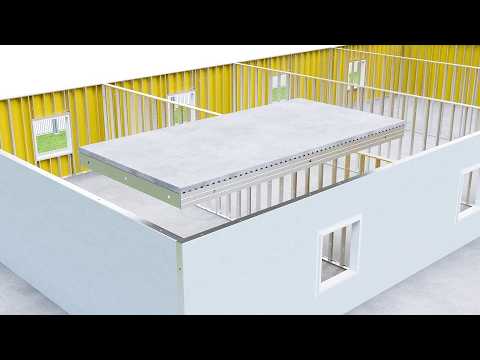
HFX builds with cold-formed steel instead of wood. As Khalid put it in an interview with BuildSteel, wood-framed apartment buildings usually stop at four stories, while their steel system goes up to seven. The walls and floors are made as panels in their shop, then put together on site.
The selling point is speed. The problem is that a finished building doesn't show how it was built. HFX wanted an animation that does:
The audience is developers, general contractors and builders who know construction well. If a layer is missing or in the wrong order, they'll notice.
There's plenty of generic steel framing content online, and it would have been easy to build this from stock models and a few searches. It would also have been wrong. HFX's panels are their own system, and the details that make it different are exactly the ones a generic model gets wrong.
So before quoting, we asked for a video call. Khalid walked us through the panels, the materials and how the building actually goes together on site, and we looked at his internal draft together. We only took the project on once we were confident we understood it. It added a little time at the start, and it saved a lot of rework later.
In a construction animation, the details carry the credibility. This one had to show things like DenseGlass exterior sheathing, the tape around window openings, and the load-bearing headers over every opening.
We split the project into two stages and didn't start animating until the first was signed off:
That approval step caught the changes that matter, such as extra studs around the panel perimeter and more detail around the windows. Fixing those on a still model was quick. Finding them after the animation was rendered would have meant redoing scenes, and pushing out the deadline and the budget.
The finished layers read clearly on screen:
| Assembly | Layers, inside to outside (bottom to top for the slab) |
|---|---|
| Window opening | LGS wall panel → exterior sheathing → wood bucks → building wrap → window flashing |
| Floor slab | LGS floor panel (steel) → corrugated metal decking → lightweight concrete topping |
Once the animation was working, a new question came up: technically correct isn't the same as ready for the website. HFX wanted it to look like their brand and sell the system, not just explain it.
The late changes were mostly about presentation:
These were quick turnarounds, and none of them touched the approved models, which is the payoff of doing modeling first.
When Khalid saw the final version, he wrote:
"Honestly this is exactly what I had in mind. I am really happy with it."
When we agreed the price at the start, Khalid wasn't sure yet what quality to expect, so he set part of the fee aside as a bonus: if we did a really good job, he'd pay it. When the project wrapped up, we reminded him of it, and he was glad to pay. His review afterwards:
"Acoroid's work in 3D product animation was great. Communication and responsiveness was good, and he took time to understand my project and vision I had in mind."
— Khalid Al-Hammadi, President, HFX Steel Framing Solutions
HFX's product line will keep changing, and a new panel type or detail shouldn't mean a new video from scratch. We back up all the project's source files, so when HFX needs an update, we open the existing scene and change what's needed.
Yes, but not from stock models. We start with a call to understand your panels and materials, then send screenshots of every modeled component for your approval before any animation starts.
Yes. For HFX we showed the floor slab (LGS floor panel, metal decking, concrete topping) and the window opening (LGS wall panel, sheathing, wood bucks, building wrap, flashing) building up layer by layer.
The HFX animation took 21 days for a six-story building with layered wall, floor and window details.
Yes. HFX started with a rough internal draft. We used it as a reference for sequence and intent, and rebuilt the models and animation to a professional standard.
Yes. We keep the source files backed up, so updates start from the existing scene instead of from scratch.