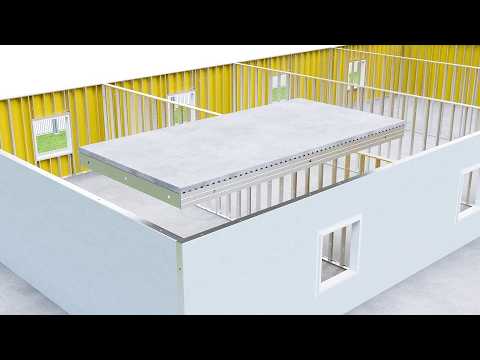
Nuance Energy was launching the Osprey PowerNEST®, a solar racking system built from fiberglass rods, crimped plates and a small set of parts. They needed a step-by-step 3D assembly animation for the product's landing page, with a hard deadline 10 days after work started. We built it from their STEP files, worked through feedback from Tom, their engineer and their CEO, and delivered on the deadline in two versions.

Tom at Nuance Energy first asked for a 20–30 second assembly video. He sent the full STEP assembly and described the order: foundation rods, base plate, top plate, purlin, tilt bracket, solar panels, top clamp, then cable bracing. For each part he wanted an exploded view, then the part coming together, then a pause with text about the engineering.
We looked at the part count and the pauses and told him straight away it would run closer to a minute. Every pause needs time to read, and cutting them would defeat the point. As steps were added along the way, it grew to just over 90 seconds, which Tom was happy with.
Two moments mattered most to Tom: the top clamp and the tilt bracket, the only complex parts in the system. And he wanted to see the top clamp's teeth actually bite into the solar panel frame. That's the detail that tells an installer the panel isn't going anywhere.
By the time the project was approved, the launch date was 10 days away. There was no room for a big revision late in the game, so we set up the project to catch problems early:
Tom was quick to respond throughout, often late at night his time, and that made the schedule possible.
The audience is solar installers and the people who buy racking for their projects. They'll judge the product by whether the animation matches how it's really built.
We delivered two versions, with and without the earth anchor step, so Nuance Energy could use the one that fit each installation type.
The final render was already running, on extra rented GPUs to make the deadline, when Tom sent an urgent message: their engineer had spotted that the cable bracing steps were in the wrong order. The choke loop at the base plate had to come first, then the top plate connection.
We stopped the render, reworked the cable bracing sequence using the engineer's sketch and a reference video Tom sent, and rendered again. Getting it right mattered more than the extra hours.
Then came the text. Tom asked for "vertical rods" to become "foundation rods" throughout, and said one longer caption was hard to read in time. Rather than stretch every caption, we gave long captions 0.75 seconds more and left short ones as they were.
The video was delivered on the launch deadline. A few hours later, Nuance Energy's CEO reviewed it and sent a list of 14 final changes: a new logo, longer holds on key shots, text edits and one stray arrow to remove. We turned all 14 around the same day.
When the final version came through, Tom's first message was:
"This is fantastic. Thank you! … What is crazy to me is how well it turned out."
And in his review:
"Astounding attention to detail and strong work ethic. Very satisfied."
— Tom, Nuance Energy
Before the project was even closed, Tom was already planning the next ones: rooftop renders of the PowerNEST, and videos for the new ground, tilt and rooftop versions once the designs are finalized.
Yes. Nuance Energy gave us an instruction document with every step, and we built the video to follow it, with on-screen captions at each pause.
Long enough to read every step. Tom asked for 30 seconds, but with eight components and a text pause for each, just over 90 seconds was what it honestly needed.
Yes. To save time and cost, we showed photos of the crimping tool and cable tensioner beside the animation. If a tool needs to move in the animation, we model it.
This one went from start to the launch deadline in 10 days. It works when drafts are reviewed quickly and feedback comes in one consolidated list.
Yes. Nuance Energy got two versions, with and without the earth anchor step, from the same project.